
reDiscover Buster Keaton
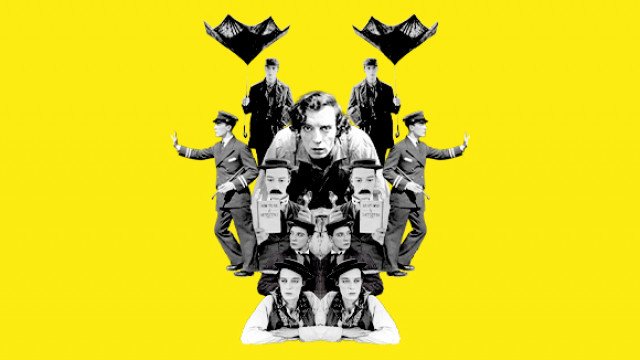
The year is 1920. Silent picture bigwig Roscoe Arbuckle pens a letter to a proto-mailing list of 25,000 film fans: "I am sending you a photograph of 'Buster Keaton,' the sad-faced little fellow who used to star in my pictures." Arbuckle, largely credited with plucking the rambunctious young vaudevillian from the stage to star in his two-reeler comedies, had indeed attached an in-profile shot of a wide-eyed, plaintive looking man with a pork-pie hat atop his head — all features soon to become synonymous with one Joseph Frank Keaton. Owing to a prophetic tumble down the stairs at six months old, Joseph would become known as Buster, who'd go on to become a true auteur of physical comedy, and one of the most recognisable faces in film history, whose schtick stands up to scrutiny just as much today as it did a hundred years ago.
Off the back of the audience he accrued from his work with Arbuckle in the burgeoning silent comedy scene of the late 1910s, Keaton found the means to start the eponymous Buster Keaton Productions: a studio dedicated to bringing his expansive visions and slapstick gags to life on a scale he'd only previously dreamed of, without any creative compromise. Between the years of 1920 & 1928, Keaton directed and starred in 19 two-reeler shorts and 10 feature films under his own production unit, largely positioned as the loveable underdog up against more and more insurmountable odds (with capers aplenty along the way). This impressive filmography more than cemented his endearingly stone-faced character firmly in the cinematic canon, despite how the big studios would treat him as the age of the talkies would dawn.
Arbuckle signed his letter off with: "If you want to see them, ask the manager of your local moving picture theatre when he is next going to play 'Buster' Keaton's comedies and he will give you the exact date," and that we will! From 19 January, see a hand-picked selection of Buster's best from his legendary tenure at Buster Keaton Productions on weekly rotation at Picturehouses nationwide.
THE LINE-UP
Go West (1925)
"Go west, young man, go west," declares a statue of Horace Greeley, a spectre that gently haunts Buster on his great journey through (and indeed, riff on) the burgeoning Western genre. We meet his hapless, 'friendless' hero at his wit's end, trading in all his worldly possessions in pursuit of a new beginning. Hopping aboard a freight train going anywhere, he stumbles upon a remote ranch where he dons a pair of chaps and asks the cattle hand if they require a new cowboy. This would give way to a nuanced turn on the unflinching machismo audiences at the time would typically expect from the leading man of a Western picture — stripping him of all the bravado and costume, guided by a want to belong rather than a need to conquer.
It's here that Buster meets his greatest on-screen match in the form of Brown Eyes, a distinctively beautiful cow. The intuitive bond they immediately share marks a turning point from the film's lonely beginnings, as they take turns protecting one another and find a shared solace amid their harsh surroundings. It's perhaps the closest any of his scene partners have come to truly understanding Buster's on-screen persona for all his quirks and sensibilities, and certainly, the most unconditionally we ever see him loved – they quite literally drive off into the sunset together.
Culminating in a stampede of cattle chasing a red devil costume-clad Keaton through the streets (which they had to be coaxed to do, as the herd would outright refuse to turn on their fearless leader), Go West is a total reinvention of a genre that wasn't even yet sure of itself, and a compelling argument for cow as man's best friend.
Steamboat Bill, Jr. (1928)
Even if this is a first-time viewing, there's a good chance that you're more familiar with Steamboat Bill Jr. than you might think. This story of two rival steamer families sees Keaton pull off perhaps the most icon
Tickets
Buy tickets at Duke of York's PicturehouseRelated
Wildwood
28 Oct 2026 – 24 Dec 2026
Duke of York's Picturehouse (Brighton)
Ghosts: The Possession of Button House
28 Oct 2026 – 27 Dec 2026
Duke of York's Picturehouse (Brighton)

Cinema City Norwich
28 Oct 2026 – 9 Nov 2026
Duke of York's Picturehouse (Brighton)
La Bola Negra
28 Oct 2026 – 11 Nov 2026
Duke of York's Picturehouse (Brighton)